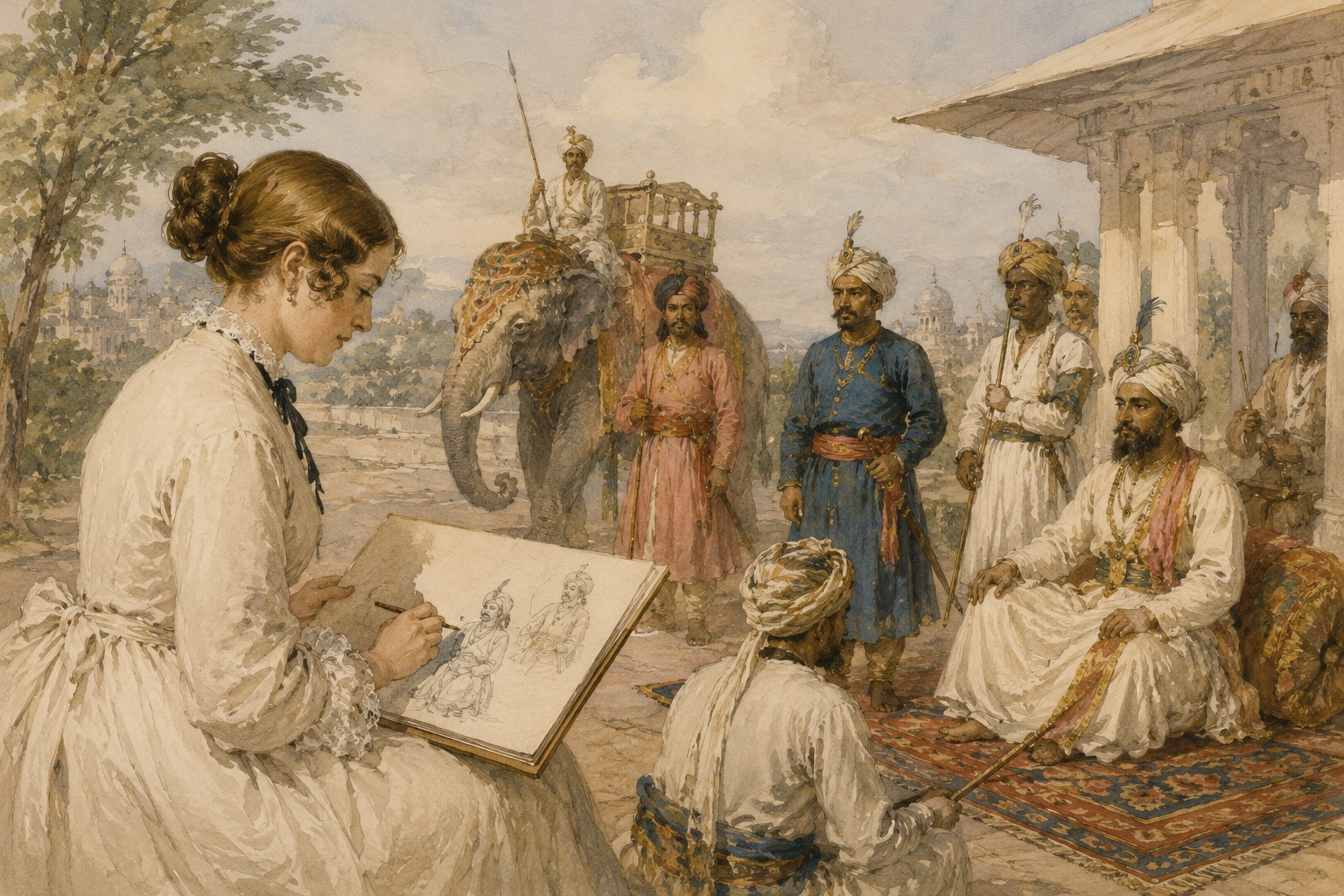
Long before photography became the primary way of documenting life in colonial India, English artist and writer Emily Eden created a remarkable visual record of the country's people, landscapes, and royal courts through her detailed sketches and paintings.
Emily Eden arrived in India in 1836 alongside her brother, George Eden, the Earl of Auckland, who was serving as the Governor-General of India. During her six-year stay, she traveled extensively across northern India, carefully illustrating the diverse communities, rulers, soldiers, travelers, artisans, and everyday people she encountered.
Unlike many artists of her era who focused mainly on colonial officials and grand architecture, Eden captured a broad cross-section of Indian society. Her artwork featured princes, Sikh and Afghan nobles, Akali warriors, attendants, hill communities, religious figures, and even the animals that accompanied royal and military processions. Her keen eye for detail has made her work an important historical record of India during the 19th century.
Her collection of sketches was published in 1844 as Portraits of the Princes and People of India, a series of hand-colored lithographs that documented India's rich cultural diversity before photography became widely available. Today, these works are being showcased in the exhibition "Princes & People" at Delhi's DAG gallery, highlighting her artistic legacy and historical significance.
Although Eden initially struggled to adapt to India's climate and culture, her curiosity gradually transformed her experience. Through both her paintings and personal journals, she documented daily life, local traditions, architecture, and the changing political landscape of the Indian subcontinent with remarkable accuracy and vivid storytelling.
Among her most valuable works are sketches created during the final years of Maharaja Ranjit Singh's reign, offering historians a rare visual glimpse into one of the most powerful kingdoms in pre-colonial India.
In addition to her artistic achievements, Eden became a respected author. Her travel writings, including Up the Country and Letters from India, provided readers in Britain with detailed accounts of Indian society, customs, and landscapes during the colonial period.
While her work reflected the colonial attitudes common among many British officials of the time, modern historians continue to value her paintings and writings as an important visual archive of India before the widespread use of photography. Emily Eden's sketches remain a unique historical record, preserving moments of Indian life that might otherwise have been lost to history.
Comments (0)
Sign in to join the conversation.