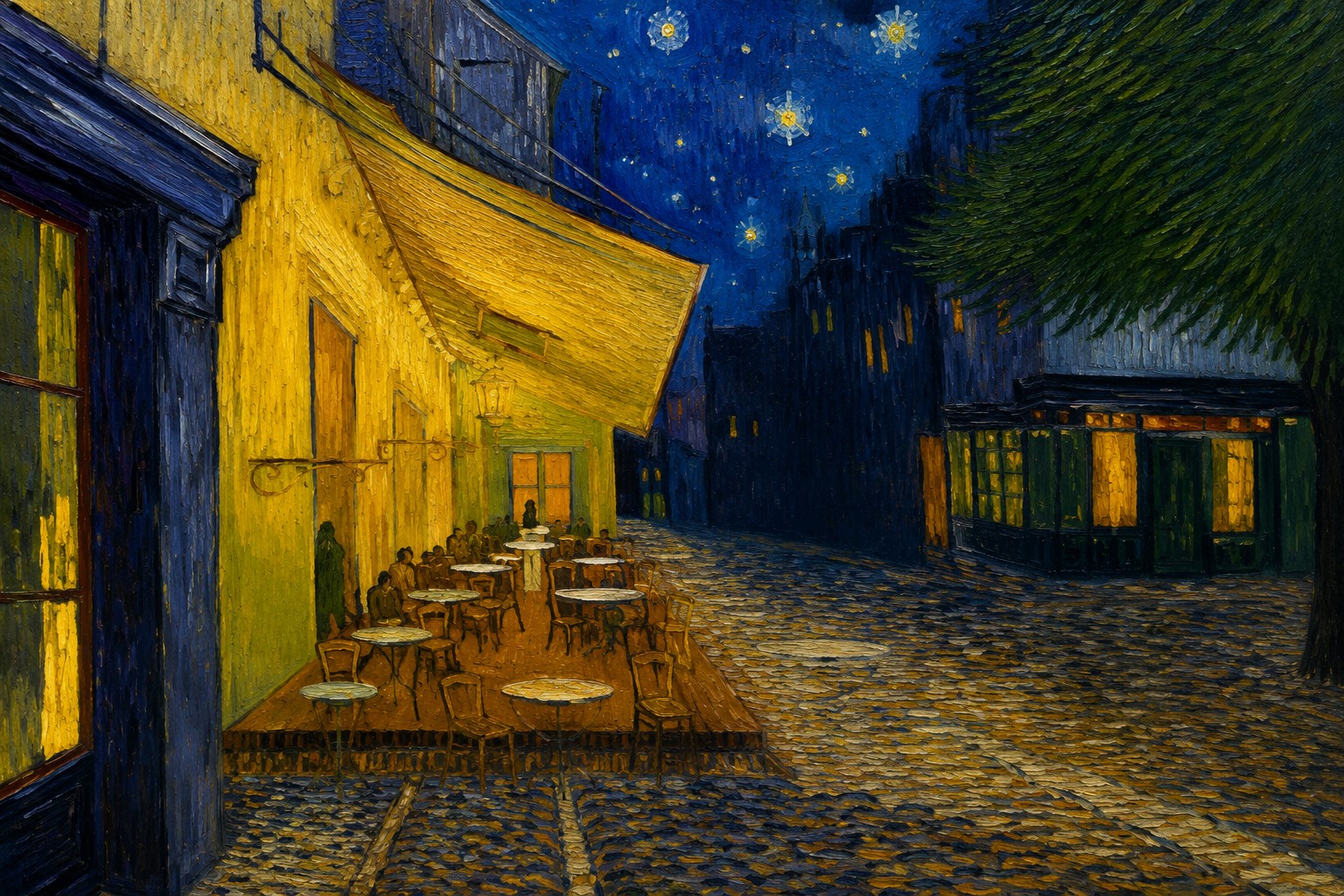
Long before Vincent van Gogh created his world-famous masterpiece The Starry Night, he painted another remarkable night scene that introduced his fascination with the stars. Completed in September 1888 while living in Arles, France, Café Terrace at Night transformed an ordinary city square into a glowing, dreamlike vision filled with artistic symbolism and emotional depth.
The painting marked a turning point in Van Gogh’s career. Seeking creative renewal and a new artistic direction, he moved to southern France and began exploring ways to capture not just what he saw, but what he felt. In Café Terrace at Night, he blended reality with imagination, creating a scene that feels both familiar and timeless.
Several subtle details help explain why the painting remains one of Van Gogh’s most celebrated works.
1. The Colorful Cobblestones
The vibrant cobblestone street dominates the foreground and reflects the warm light spilling from the café. Rather than using black to depict the night, Van Gogh relied on blues, violets, pinks, and yellows to create depth and atmosphere. The textured street also hints at the layers of history beneath the city, connecting the present moment with the past.
2. The Missing Roman Columns
Historical records show that ancient Roman columns once stood prominently in the square. Instead of including them, Van Gogh deliberately replaced these remnants of antiquity with ordinary storefront details. The choice shifts attention away from history and toward the living, changing world around him.
3. The Empty Chairs and Tables
Although the café appears lively, many of the tables and chairs in the foreground remain empty. These vacant seats create a sense of anticipation and mystery, inviting viewers to imagine themselves within the scene while adding emotional depth to the composition.
4. The Distant Tower
A shadowy tower rises in the background, guiding the viewer’s eye upward toward the night sky. The structure serves as a symbolic bridge between everyday life below and the vast, infinite universe above, reinforcing themes of reflection and spiritual exploration.
5. The Carefully Positioned Stars
Unlike many of the painting’s altered architectural details, the stars appear to be placed with remarkable accuracy. Researchers have found that the celestial arrangement closely matches the night sky over Arles in September 1888. Their precise placement reflects Van Gogh’s fascination with the cosmos and his desire to connect earthly life with something greater.
Together, these elements reveal how Café Terrace at Night became far more than a simple street scene. Through color, composition, symbolism, and imagination, Van Gogh transformed a quiet café terrace into a vision of wonder that foreshadowed the brilliance of The Starry Night. The painting remains a powerful example of how an artist can turn everyday reality into something extraordinary.
Comments (0)
Sign in to join the conversation.